Internal Tool — Game Development
Elements
Admin
A content management system for a 118-card periodic table card game — built before the game engine so there's a proper database to build against.
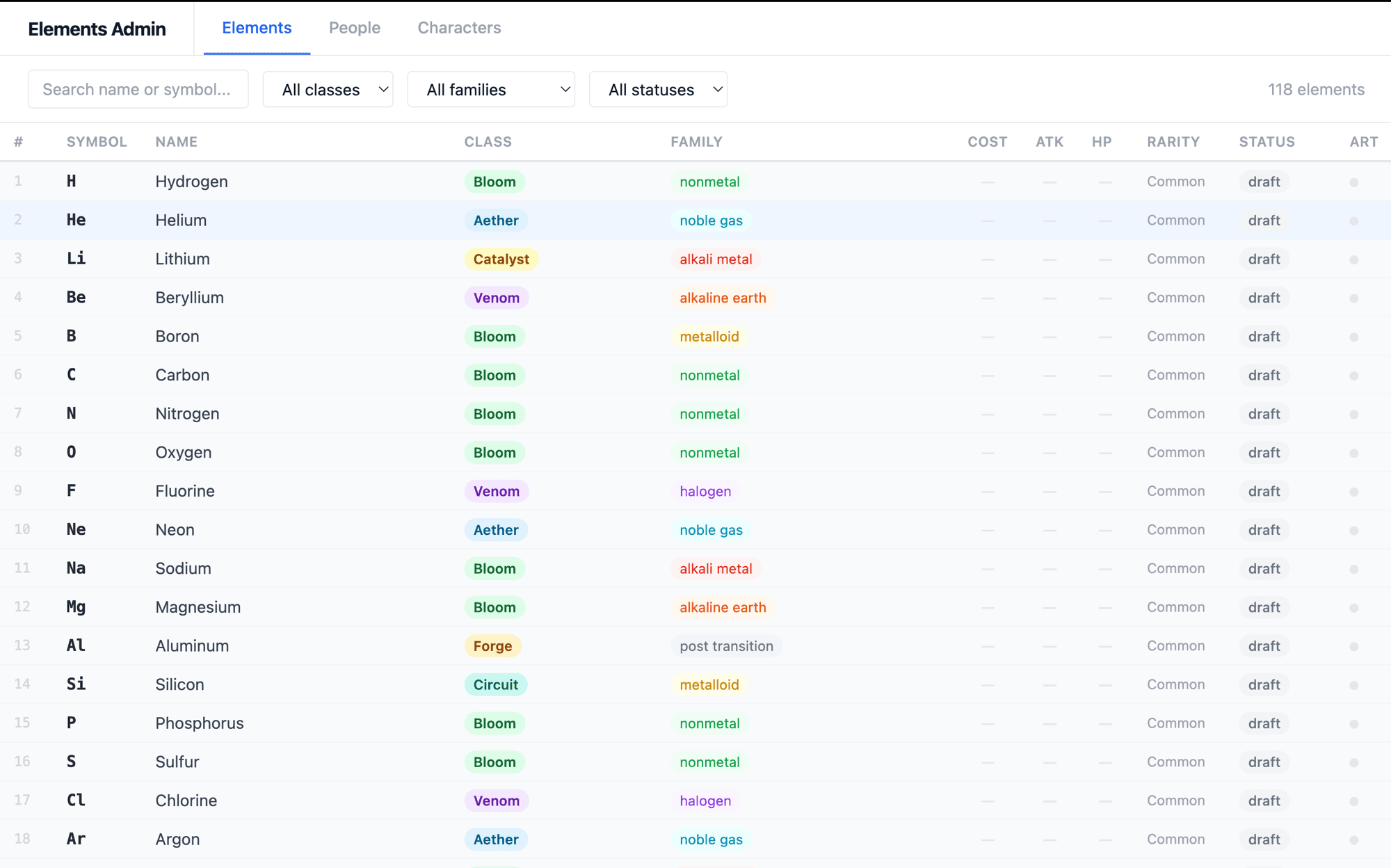
All 118 elements sorted by atomic number. Class badges (Bloom, Aether, Forge, Circuit, Venom, Catalyst) and family labels are color-coded independently. Filterable by class, family, and status.
The brief
A developer building a card game around all 118 periodic table elements needed a way to author every card before writing a line of game engine code. Each element requires game stats, a character identity, lore, a named ability, and artwork — across 8 game classes and 10 periodic table families. Without a proper content management system, the whole project would eventually be held together by spreadsheets.
The approach
The database was seeded with all 118 elements from the real periodic table — atomic number, mass, period, group, family, and radioactive/synthetic flags — so none of that had to be typed manually. The admin tool adds the game layer on top: stats, class assignment, ability writing, artwork tracking, and design status. The game engine reads only cards marked Complete or Balanced, which means the authoring work happening now directly feeds the game the moment the engine is ready.
What was built
118 elements, fully seeded
Every element from Hydrogen (1) to Oganesson (118) is in the database with its real atomic number, mass, period, group, family, and radioactive/synthetic flags — no manual entry needed.
Two-layer card identity
Each element has a Class (deck archetype — Forge, Circuit, Nucleus, Bloom, Aether, Venom, Catalyst, Void) and a Family (periodic table group — alkali metal, halogen, noble gas, etc.). Both are independently filterable.
Game stat editing
Electron cost, attack, HP, rarity, decay counter, and decay product are all editable per card. Status tracks progress: Draft → In Review → Complete → Balanced.
Notable people / scientists
15 scientists linked to the elements they discovered, isolated, or were named after — Mendeleev, Marie Curie, Seaborg, Fermi, and more — with biography, contribution, and game angle fields.
Character development page
A dedicated workflow for assigning personality references to all 118 cards. Each element can hold multiple references with notes on what specifically maps to that card.
Status-gated game engine
The game engine only reads cards with Complete or Balanced status. Design and production are cleanly separated — nothing unfinished reaches the game.
Inside the tool
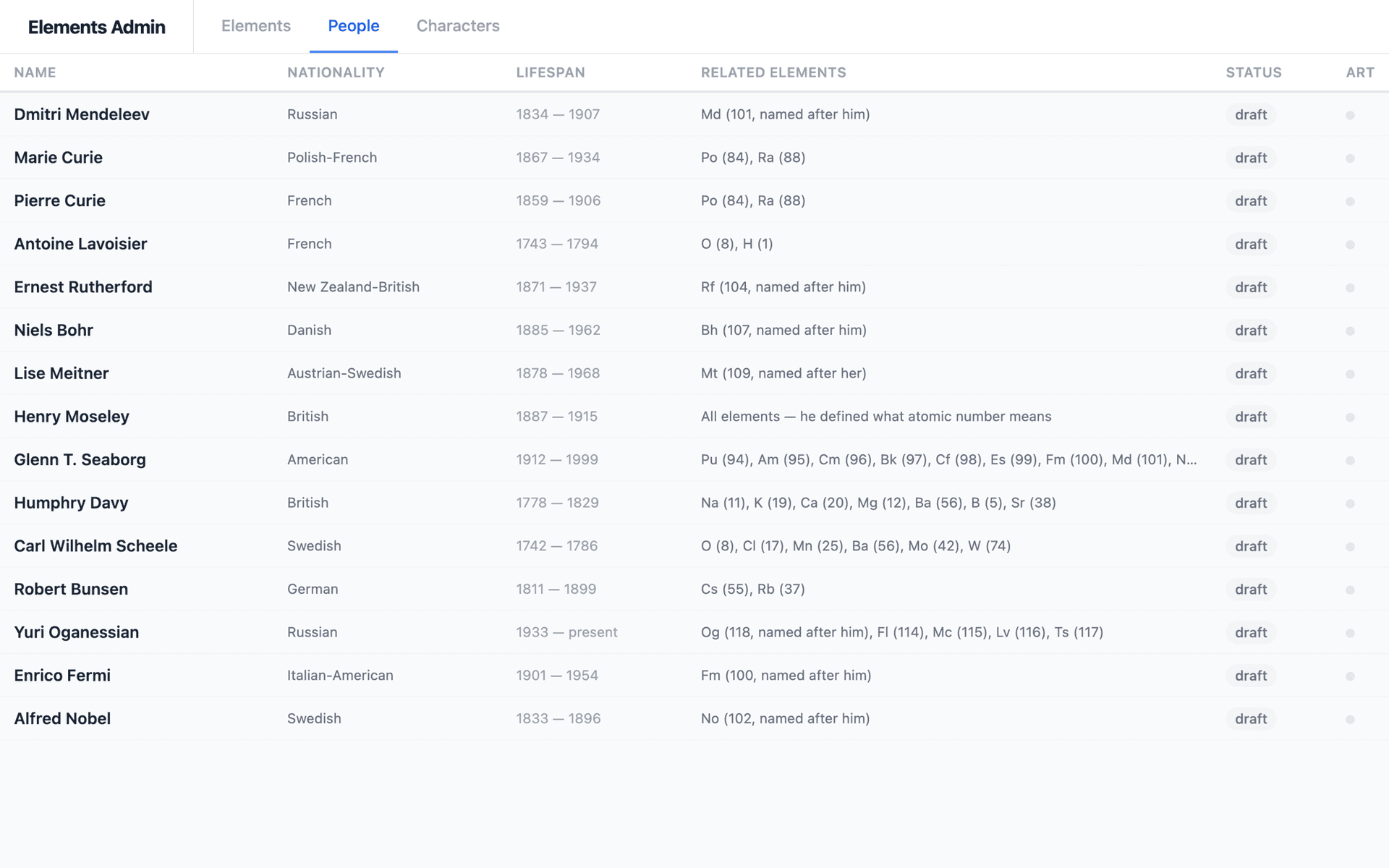
People tab — 15 scientists linked to the elements they discovered or were named after. Mendeleev, Marie Curie, Seaborg, Fermi, Nobel, and more, each connected to their elements.
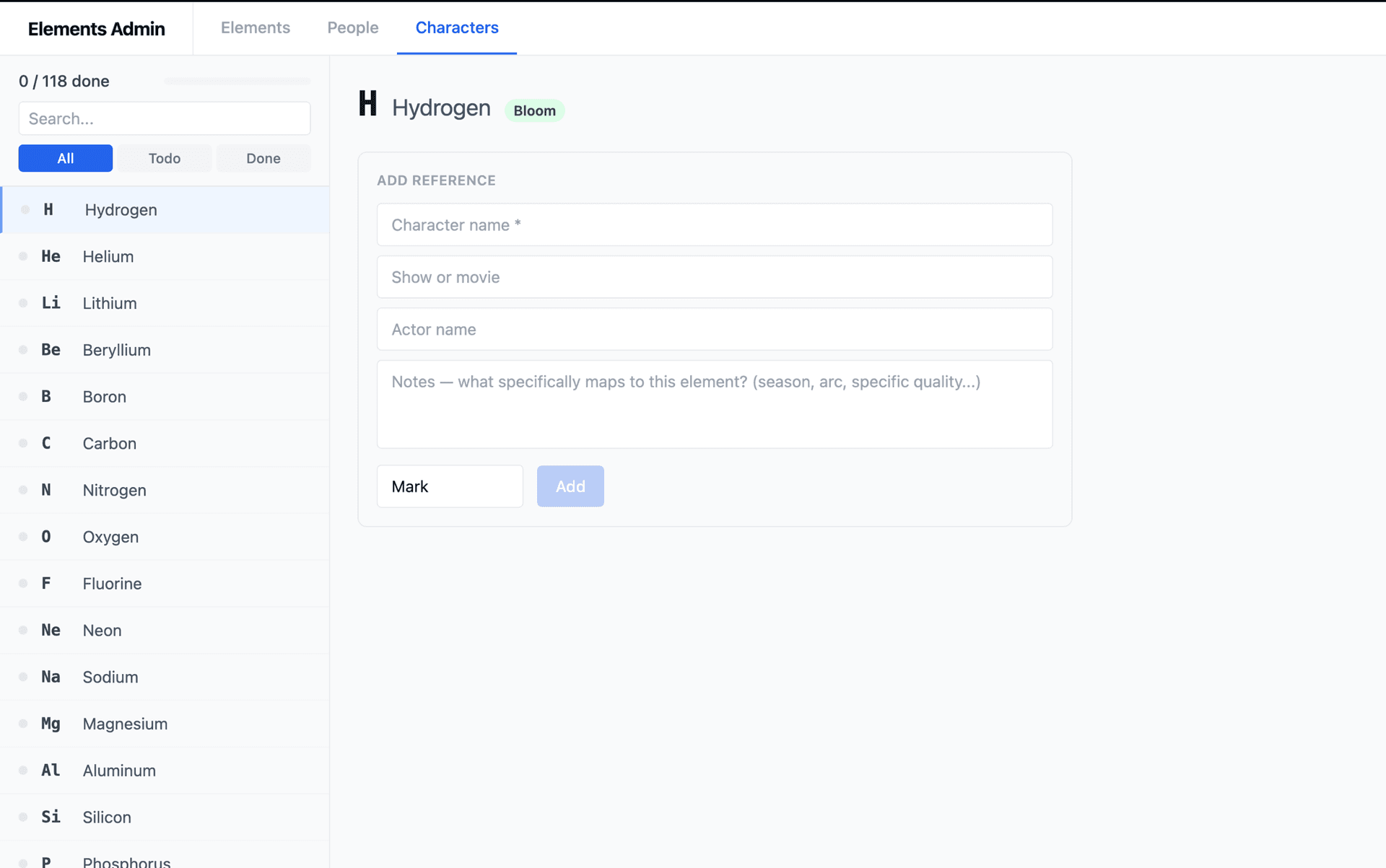
Characters tab — personality reference workflow for all 118 cards. Each element gets film/TV character references that anchor its voice before flavor text and ability descriptions are written.
The result
A structured authoring environment for a project that would otherwise sprawl across spreadsheets and documents. Every card has a home, every stat has a field, and the game engine has a clean data contract to build against. The tool does its job invisibly — when the game ships, nobody sees it, but it's the reason the game could be built at all.
Need a tool built for your project?